This week I’m repurposing some information I received yesterday from JPMorgan. The first part is a quick look at imbalances in the stock market right now. The second part is the annual update to the firm’s long-term market assumptions which, when coupled with other sources, helps set the strategic tone for our plans.
First, to the imbalances we’ve reviewed several times already, but a reminder is always good. Stocks were down last week at the macro level from 1.5% to over 5%, depending on the index. But of the 11 sectors making up the S&P 500, seven were positive for the week. How’s that possible when index performance was negative? Tech was down nearly 8%. That sector is worth over 40% of the index and that performance watered down other sectors like Consumer Staples, Energy, Healthcare, and Materials. Each of those were up over 3% on the week but cumulatively make up barely half of Tech’s weighting. And if you’re wondering, the 5% decline last week came from the NASDAQ index, of which over 60% is Tech.
Still, tech has been doing well for some time and in some ways has been holding up the market indexes. That’s been shifting lately for various reasons, but other sectors have started pulling their weight.
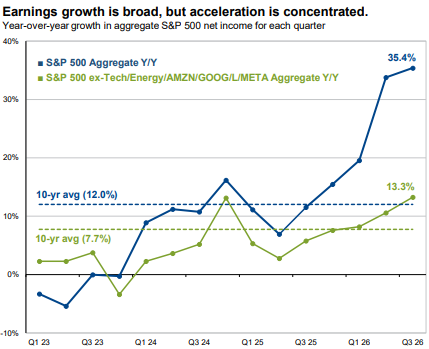
Along these lines, here’s the first update from JPMorgan I mentioned, which is a snippet from a Weekly Market Recap that shows up in my inbox on Mondays. The piece discusses how net income from S&P 500 companies is expected to grow at a 35% rate compared to a year ago, about 3x the longer-term average. That’s a continuation of the Tech story, but you’ll see how expectations for the rest of the market have picked up steam as well.
As this week’s chart shows, earnings are expected to grow 13% after excluding the Technology and Energy sectors and three AI-related companies: Amazon in Consumer Discretionary and Alphabet and Meta in Communication Services. While that is well above the 8% average of the past decade, the widening gap highlights where the acceleration is coming from. Together, the excluded sectors and companies are expected to contribute nearly 77% of the increase in S&P 500 earnings this quarter.
Slower does not mean weak. In fact, analysts became more optimistic as the quarter progressed. Third-quarter earnings estimates increased 1.4% between June and September, compared with an average decline of more than 2% in a typical quarter. A record 72 companies also entered reporting season with guidance above consensus, suggesting the optimism is coming from companies as well as analysts.
For investors, the distinction between breadth and acceleration is important. Earnings growth has broadened well beyond a handful of companies, providing a healthier foundation for the market. However, the acceleration in profits remains concentrated in areas benefiting most from the AI investment cycle and stronger energy earnings. With valuations elevated, continued market gains may require both sides of the earnings story to hold: exceptional growth from the leaders and durable, above-trend growth from everyone else.
The second part I wanted to share is my quick summary of JPMorgan’s recently updated long-term market assumptions. This 31st annual release is meant for professionals but, as you can imagine, is helpful for anyone trying to play the long game (a 10-15yr time horizon in this context) with their investment strategy.
Perhaps most importantly, the research shows clear-eyed bullishness for the US and global economies. Investment in AI-related infrastructure is a big part of this, and so are anticipated productivity gains that analysts suggest could help offset inflation and continued demographic shifts. For example, the report suggests that by 2040 AI could be used in roughly 40% of tasks completed by workers, leading to a 30% productivity gain per worker (on average), and allowing more to be done with less.
Analysts acknowledge these forecasts may seem at odds with recent headlines, but they try to lean on facts, so that explains some of the variance.
The US is expected to grow faster than the rest of the world because most of the AI-related investment (plus other forms of investment by government and private industry) is expected to happen here, double or triple potential investment from Europe and Japan, for example.
JPMorgan sees “economic nationalism” as a modest growth risk but more of an inflationary risk (from continued tariffs, for example). There are some words about sovereign debt levels and how investors maybe shouldn’t assume that government bonds are as risk free as they once were, compared to bonds issued by corporations that might manage their books better than a government. (Ouch!)
The K-shaped economy, and the divergent needs of each leg coupled with the political/societal/cultural issues associated with it, is also expected to continue for the report’s 10-15 yr time horizon.
In general, JPMorgan’s research team expects higher returns for stocks and bonds, but also more market volatility. Analysts also make the case for more diversification for portfolios by including alternative asset classes like real estate, private equity, and private credit. Their main point is that typical asset classes like stocks and bonds are expected to march more in step and investors may have to look further afield for diversifiers. I’m not a fan of some of those options, but there are broader ways to think about them.
Regarding specific average return forecasts, JPMorgan expects...
3.2% on cash
4.6% on medium-term Treasuries
6.1% on investment-grade corporate bonds
6.7% on higher-risk bonds
7.5% on US large cap stocks
7.5% for the global stock market
Interestingly, bitcoin was included in the report for the first time. Among the issues with including bitcoin in an asset allocation is its relationship to other asset classes being so unstable. Still, some investors are obviously holding bitcoin, and expectations are all over the place. One example in the report is a base case average annual return potential of 10.7%, but also a “bear case” average annual return of -9.7%, plus a bullish case for 17% average annual. Which do you think is most likely? What portion of your portfolio would you allocate to bitcoin at this point?
For my part, all this speaks to paying even more attention to diversification in the context of a portfolio that’s built specifically for what the client needs. Are you in growth mode? Then load up on US stocks, be prepared for volatility, and adjust your sector exposure as needed. Are you nearing the point when you need to spend your savings? Then keep your stock exposure and be diligent about diversification and protecting your income sources.
This work is never easy but, if this report is right, at least we’ll continue to have a tailwind for a while.
Have questions? Ask us. We can help.
