As I mentioned in my post last week, we have a new Chair of the Federal Reserve, Kevin Warsh. At age 55, he’s the youngest to serve as Fed Chair. Mr. Warsh graduated from Stanford and Harvard Law School and has been in government service for around 20 years and is married to the heiress of the Estee Lauder cosmetics fortune.
While Mr. Warsh is highly regarded for his work in government and the private sector, his views on monetary policy and the Fed have naturally evolved over time, so market participants are anxious to see how he plans to put his stamp on the world’s most important central bank. The next Fed meeting is in a couple of weeks, so that’s likely to be an interesting press conference.
As a reminder, the Fed Chair is chosen by the US president and approved by the Senate, but the Fed is meant to be independent of the Executive branch. The Fed’s main jobs are to maintain a sustainable rate of inflation and foster a healthy job market. Among other duties, the Fed Chair leads an Open Market Committee that directs the government’s monetary policy and is the public face of that policy. The Chair’s statements, even body language and tone, are dissected for clues about the health of our economy and the trajectory of interest rates. In short, it’s a hugely important job on the domestic and global stage.
Chair Warsh takes the helm from Jerome (Jay) Powell who served as Fed Chair from early 2018 until about a week ago. Serving as Chair for eight years, Powell’s tenure is tied for third with Paul Volker and behind Alan Greenspan who served nearly 19 years. William McChesney Martin Jr’s tenure is longest after serving for 19 years during the 50’s and 60’s. While no longer Chair, Powell will continue in his role as one of the governors of the Fed system until that term ends in 2028.
Perhaps every Fed Chair sees a lot of tumult if they’re in the job long enough, but Jay Powell certainly saw his share. Wars (“shooting” and trade-related) and technological changes come to mind. As does dealing with the capriciousness of the president who elevated him to Fed Chair. Late night tweets from the Trump administration about the Fed’s interest rate policy, “enemies” at the Fed being “insane” by not lowering rates faster, even being accused of lying to Congress and then being “fired” in the press… talk about a hostile work environment.
But the biggest issue Powell contended with was the government’s response to Covid. We all know the timeline but imagine being Fed Chair in March of 2020 as federal and local governments were trying to close the economy and you’re one of the few people charged with keeping a lid on the situation, at least from a global economic and financial markets perspective. The typical economic playbook didn’t apply because the situation was far from typical, and yet the Fed Chair (and the entire system) had limited and rather blunt tools to address the problems, both known and unknown. Still, many actions had to be taken and the rest, as they say, is history.
Through it all and on balance, I think Jay Powell did a great job as Fed Chair given the circumstances.
I also think that much of the criticism thrown his way was and is a classic case of Monday morning quarterbacking. Yes, massive injections of capital into the economy eventually caused an inflation spike in 2022 and other issues that the Fed was too slow in responding to and that, in some ways, still linger today. And yes, income inequality has risen dramatically since Covid, but I don’t think we should lay that at Jerome Powell’s feet. I think he and the rest of the Federal Reserve system did the best they could amid unprecedented circumstances. We’ll never know what might have happened in the economy during Covid had the Fed done less with monetary policy, and for that I think we can all be thankful.
At least from a financial markets perspective, Powell’s full tenure was successful. The following charts and commentary are from my research partners at Bespoke Investment Group.
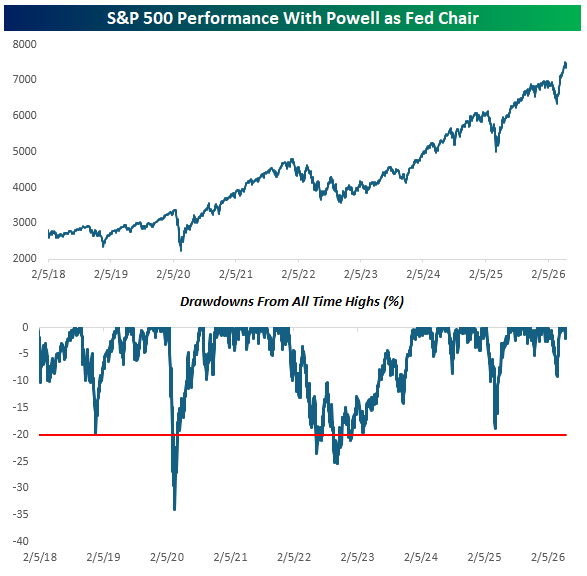
The chart below shows the S&P 500’s performance during Powell’s tenure, which has been much better than the President’s rhetoric towards the former Fed chair would suggest. During this period, the S&P 500 has more than doubled from under 3,000 to over 7,000. While the point-to-point gains have been strong, it’s been a pretty volatile ride.
The lower chart shows the S&P 500’s drawdowns from all-time highs throughout Powell’s tenure. During that time, the S&P 500 experienced two bear markets and two near-bear markets in which the S&P 500 declined close to 20%. In most cases, though, the declines were short-lived, and outside the 2022 bear market, after each prior bear or near-bear, the S&P 500 was back at new highs within weeks or months.
Through Friday morning, right up to the swearing-in ceremony, the S&P 500’s annualized gain during Powell’s tenure was 13.4%. Relative to Powell’s peers, the only Fed Chair since WWII who presided over a stronger stock market was Paul Volcker. Powell’s performance is tied with William Miller, who preceded Volcker, but he was chairman for less than two years, or less than a quarter of the time Powell had the same role.
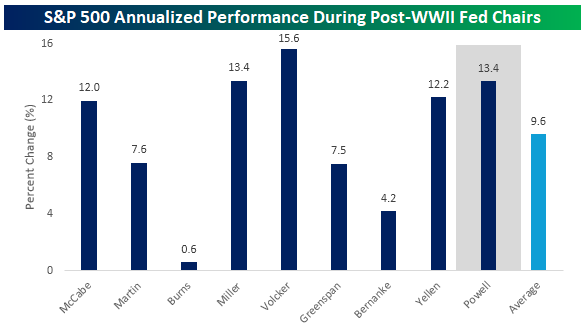
President Trump is almost certainly thinking good riddance [on Powell’s last day as Fed Chair], but from a strictly stock market perspective, it doesn’t get much better, or as the President or new Fed Chair would probably say, “at least not yet.”
Have questions? Ask us. We can help.
