Skipping this Week

Good morning. Unfortunately we had a death in the family in recent days and that’s set me back a bit with work. I’m going to skip this weekly post but will be back at it next week.

Until then, consider taking ten minutes to review the ownership and beneficiary designations on your different financial accounts. These are easily changed during your lifetime but are pretty much etched in stone after death.

Here are a few basic questions to answer:

Are you married and own any accounts in your own name? Is this on purpose?

There are various reasons to keep money separate from a spouse, but accounts owned in your own name and that lack a beneficiary designation will likely go through probate. Sometimes this is a good thing, but probate is usually something to be avoided if possible. Ideally any accounts owned just by you would have beneficiaries, even bank accounts.

Are your life insurance, IRA and 401(k) beneficiary designations set up the way you want?

This is easily changed but often overlooked. Is your ex-spouse still listed on your account? Or maybe you listed “estate” as your beneficiary, ensuring your account will go through probate. Is that what you want?

Does your spouse feel comfortable (or at least moderately comfortable) with how you have the household’s finances setup?

In other words, how steep will the learning curve be after you’re gone? Is information easily accessible and understandable by your spouse (or others) if you’re not there to explain it? Have you simplified as much as possible or does your financial picture resemble a Jackson Pollock painting?

There are more questions, of course, but that’s a start. Think seriously about this because errors and other miscalculations can result in major headaches or worse for your loved ones after you’re gone. I’ve talked before about taking ten minutes each workday to focus on your finances. This simple exercise is a great way to spend that time periodically, say at least once per year.

Have questions? Ask me. I can help.

  • Created on .

Social Security Update

We heard some good news for a change late last week. Next year’s cost of living adjustment for Social Security beneficiaries will be 8.7%, the largest annual increase since 1981. Beneficiaries will start seeing this in January and the link below takes you to SSA’s blog for more information on how to see yours if you’d like to know sooner.

This COLA comes at a great time for the roughly 70 million Americans receiving Social Security. The SSA says the average benefit will go up by about $140 per month, so that will help take the edge off inflation running at an 8.2% annual clip as of September. Additionally, this is the first year in a while that Medicare premiums aren’t increasing – they’re actually going down little, making the COLA that much more valuable for retirees, especially lower-income folks.

And a quick reminder: If you’re eligible but haven’t filed for your benefits yet don’t worry. The COLA will be applied to your benefit base so you can keep growing it.

Here’s a link to the SSA’s blog post I mentioned.

https://blog.ssa.gov/social-security-benefits-increase-in-2023/

Extra income notwithstanding, some commentators are talking about how this benefit increase only exacerbates the problems faced by Social Security and will accelerate its demise. These concerns aren’t new. For decades a variety of folks have been banging their drums about the health of this third rail of American politics while, perhaps amazingly, benefits were continually paid.

But pessimism and fearmongering are good for business. Books, talking heads on TV, websites, and a laundry list of investment product manufacturers all operate within an ecosystem of their own creation to sell you stuff you probably don’t need. “Don’t trust a government program, trust your life savings to your friendly neighborhood insurance company instead…”. But I digress…

Here's an interesting take on this from a columnist at Morningstar, the fund ratings and analytics juggernaut residing (at least mostly) outside of the ecosystem mentioned above.

https://www.morningstar.com/articles/1116805/the-public-was-wrong-about-social-security?utm_medium=referral&utm_campaign=linkshare&utm_source=link

The bottom line on the Social Security question is to acknowledge that the program is only meant to cover roughly 40% of your pre-retirement income. Ideally your own savings and/or other income are your base and Social Security would be the extra layer it was meant to be. If you’ve planned well and keep your expenses down, maybe you can stretch your benefits further. But it’s not something to rely on completely.

Beyond that, everyone knows the recommendations to “fix” the program, but nobody in a position of authority seems interested in doing it (that “third rail” issue). It’s all too easy to get worked up about the program’s potential implosion but if the future is anything like the past, it will probably work out okay. After all, for all its problems, the federal government is one of the few entities with a true blank check. That’s not a perfect solution since the inflation we’re seeing now is one of the results of using it, but the blank check’s existence tends to help keep the wheels in motion.

And, of course, the government can always raise taxes. Benefits go up next year but so does the maximum wage income that gets taxed for Social Security, from $147,000 this year to $160,200 next year. That’s a relatively large increase impacting higher earners, so at least something is going back into the digital coffers to replace what’s being spent.

Have questions? Ask me. I can help.

  • Created on .

Quarterly Update

Updates like this one for the third quarter of 2022 (Q3) aren’t much fun to write. Instead of double-digit gains seen in recent years, losses across asset classes continued during the quarter in what’s become a gut check for long-term investors. The principal catalysts for these market conditions have been the same all year and Q3 was no different: global inflation and central bank response elevating recession risk here and abroad that increased uncertainty and market volatility.

Here’s a roundup of how major markets performed during Q3 and year-to-date, respectively:

  • US Large Cap Stocks: down 4.9%, down 23.9%
  • US Small Cap Stocks: down 2.2%, down 25.1%
  • US Core Bonds: down 4.8%, down 14.6%
  • Developed Foreign Markets: down 9.3%, down 26.8%
  • Emerging Markets: down 11.4%, down 26.9%

Global stock markets staged a bit of a comeback during Q3 until about mid-August before selling pressures mounted again. In the US, the S&P 500 (considered the simplest measure of the stock market) ended the quarter down nearly 5% and all of its sectors were down except for Energy which was up about 2%. The Communications Services sector that contains companies like Meta (Facebook), Alphabet (Google), Netflix, and Disney, continued its downward slide to about a 38% loss through quarter’s end. Even the Utilities sector, which typically holds up well during turbulent times is down 7% this year after a rough Q3. Foreign markets took a further beating with concerns about emerging economies like China. And, right at quarter’s end, fears about potentially ineffective fiscal policy in the UK impacted developed foreign markets and bled over to ours as well.

Probably the biggest issue on any given day during the quarter was the Federal Reserve’s response to inflation that continues to run hot, a little over 8% annually through September. In response to this decades-high inflation, the Fed raised rates twice during Q3 for a total of five increases this year, bringing the short-term benchmark rate it controls to 3.25% from near zero as the year began. Along the way members of the Fed continually reiterated that of their two jobs, trying for full employment and controlling inflation, the latter is the most important by far. Numerous Fed members told markets that, essentially, the Fed would bring down inflation even if a recession or other collateral damage to the economy resulted. Rapid rate increases and rhetoric like this should help slow inflation eventually but also creates a variety of knock-on effects, for which the timing and severity are unknown.

This continues to create a lot of uncertainty. For investors this means, among other things, that it’s hard to predict how much companies can grow in the near-term and what a fair price is for a company’s stock today. Some analysts think that corporate earnings will continue to grow into 2023, while others suggest that outlook is too rosy. Views on this have been shifting back and forth daily. In response, many short-term investors sell and as often happens, selling begats selling that is often indiscriminate in today’s market environment. So far this year we’ve had almost as many all-or-nothing days in the stock market as during the Covid market crisis of 2020, culminating in a drawdown of stock and bond values measured in the trillions.

That sort of selling continued in the bond market during Q3 as well, with the yield on the 10yr Treasury, a key benchmark, rising to nearly 4%, (bond yields rise as prices fall) from 1.5% in January. These numbers may seem small, but they have big impacts on bond prices and the world of finance more broadly. Examples of this were rising bond yields pushing the average 30yr mortgage rate to almost 7% during Q3, up from 3.3% in January, and the Prime Rate (on which credit card and home equity line interest is often based) to 6.25% from 3.25% a year prior.

Prices on high quality medium-term bonds fell another 4.8% during Q3 and are down nearly 15% this year. On one hand that sort of price decline presents opportunities to put cash to work at higher yields while on the other hand it hammers savers who already hold bonds. Fortunately, these bonds still pay interest and will return principal at maturity even though resale values have taken a hit in the meantime. Longer-term bonds, such as 20+yr Treasury bonds, were down over 10% during Q3 and nearly 30% this year. That’s as bad as the tech-heavy NASDAQ stock index. Typical investors don’t own a lot of long-dated bonds but declines like this are still incredibly unusual.

Stocks have been known to stage so-called relief rallies when prices fall too far too fast. The same thing is true for bonds. As I write the stock market is doing just that and the yield on the 10yr Treasury has fallen back to about 3.6%. Relief rally or not, we would welcome a rally by any name at this point in a year where there’s been nowhere for investors to hide. The last few months of the year have historically been good for investors… fingers crossed.

Like I said, market declines aren’t much fun to write about or to live through but live through them we must if we’re to build long-term wealth, generate cashflow during retirement and, ideally, leave something behind. This too shall pass, as they say, but the current environment is an opportunity to double down on our commitment to being long-term investors. It’s not for everybody and it doesn’t have to be, but short of starting your own business or becoming a real estate tycoon, investing in stocks and bonds is the best way to build your savings over time.

Have questions? Ask me. I can help. 

  • Created on .

The Optics of Reality

Trust is fundamental to our relationship with others – with other people, private and public institutions, and especially our elected representatives in government and those they appoint. In fact, our entire financial system and much of our economy is based on trust. So it hurts when those in power, those with special or “insider” knowledge, seem to use their position to enrich themselves. One might suggest that this is nothing new and that taking advantage of one’s position is as old as time. But perhaps what’s different now is that we learn about it faster and more thoroughly. It’s just too hard to hide these days.

Take recent findings by The Wall Street Journal and others that shine a bright light on stock and bond trades made by a host of government officials during the worst of the covid market crisis. A lot of this was news last year, but current reporting shows how widespread the issue was. As markets were only starting to rage into February 2020, officials at HHS and the NIH, for example, left their closed-door meetings about the looming pandemic and sold stocks. Going into the worst of the market lows a month later, officials at the Fed and even within Congress, bought stocks as both bodies were set to announce lowering short-term rates to zero and passing truly massive stimulus programs.

These trades could all have been honest coincidences, but how likely is that? An official might suggest that the trades were just normal rebalancing or were made by others such as spouses or the family financial advisor. They might also suggest that the closed-door meetings they were part of didn’t provide actionable investment-related information. Really? The timing of the trades by officials profiled in the articles below leaves little to the imagination.

The various federal agencies have their own ethics rules governing the trading of stocks and bonds by elected and appointed officials. I know from professional experience that these issues can get muddy pretty quick. Some officials simply own broad stock and bond market portfolios and buy, hold, and rebalance like the rest of us, pretty standard. Some officials trade stock in individual companies they regulate or have special knowledge of, which is an obvious ethical breach. But other officials timed their transactions in broad market funds based on special timely knowledge gleaned from their work. If those officials knew that government actions would very soon be shuttering the economy, or providing massive amounts of cash to stimulate it, well before the general public knew, and then bought and sold based on that information, doesn’t that seem just as wrong as someone engaging in insider trading? Maybe these officials could throw up technicalities in defense and skate past clear ethics violations, but the optics are horrible and further degrade our trust in the people who make up incredibly important institutions.

My understanding is that government ethics rules in this area are mostly based on disclosure, which happens maybe a month or two after trades take place, and sometimes annually. These disclosures are public but not always readily available. For example, the president of a regional Federal Reserve Bank posts their disclosures on the bank’s website, while the disclosures from other officials have to be sought out via submitting a government form. That’s what The Journal and other organizations dug into, and the results of their work aren’t flattering for a host of officials and the norms at many agencies.

Lots of people talk about things being rigged. Our political system is rigged. Our economy is rigged. And our markets are rigged to rake the “little guy” over the coals while “the man” fills his pockets past the point of spilling over. Personally and professionally, I think much of the rhetoric around stuff like this is overblown. By and large our systems work as intended while not being perfect; you just have to know how to navigate them. And that’s a big part of what I do within my own little corner of the world every day for clients. But unfortunately, news like this reenforces the public’s cynical views. How can it not?

My point with bringing all this up is to remind of us of the obvious: even officials in a position of power and trust can, and presumably often do, take advantage of their position for personal gain. They know they’ll probably be caught and, if so, they just apologize and move on. And their apologies in these cases have ranged from the half-sincere to, shall we say, stretching the concept of plausible deniability. I’m not naïve enough to be surprised by this behavior, but perhaps I’m still naïve enough to be saddened by it. I choose to believe in the fundamental good in us all, but there’s a little Gordon Gekko in there too and some have more than others. I hope the days of selfless acts for the betterment of society aren’t gone for good.

That said, check out these articles to learn more about this issue. Or just Google it. There’s plenty of news to go round.

The Wall Street Journal has a paywall. Let me know if you hit it and I can send the article to you from my own account.

https://www.wsj.com/articles/covid-washington-officials-stocks-trading-markets-stimulus-11666192404?mod=hp_lead_pos5

And here’s an interesting timeline from earlier this year by Yahoo! News focusing on Fed members and their pandemic trading. In some cases the officials were forced to sell their stocks and, presumably, incur the tax burden. But what about the ill-gotten gains? I haven’t read anything about sizeable donations to charity…

https://news.yahoo.com/a-timeline-of-the-federal-reserves-trading-scandal-104415556.html

Have questions? Ask me. I can help.

  • Created on .

Going Nuclear

Good morning! I hope your Tuesday is going well so far. There’s lots going on this week as usual and one piece of news I’m anticipating is the annual update from Social Security about the cost-of-living adjustment for beneficiaries next year. Estimates are in the high-8% to 9% range, according to a variety of sources, and anything close to that would be welcome news for obvious reasons. The details are expected soon, and I’ll likely post a note about them next week.

But this week let’s touch on a weighty and unfortunate question: How should we think about investing if/when it comes nuclear war? Certainly an uncomfortable departure from worrying about Fed policy, recession risk, and so forth, but some of you have asked about it so here goes…

The war in Ukraine has amped up in recent days and so has the rhetoric. Russia’s president has obliquely, or perhaps openly, depending on one’s perspective, threatened the nuclear option. The US responded with its own rhetorical volley, and this has lots of serious people talking about the increased risk of nuclear war.

The temperature rose again this weekend following the demolition of a strategically and psychologically important “Russian” bridge into Crimea by Ukrainian forces. That led to missiles being fired by Russia into areas occupied by Ukrainian civilians. These stories imply that a country and its leader are being backed into a corner from which desperate action becomes more likely. Or at least that’s what people are discussing.

Unfortunately there are no easy answers for investors when it comes to considering a nuclear crisis. It’s either all scary talk and no action or all action and, well, one can only hope that the doctrine of mutual assured destruction would cool down some heads. But is there anything investors should do to prepare? Is this even something to worry about from an investment perspective?

Here’s some insight from a note sent last week by my research partners at Bespoke Investment Group (emphasis mine).

From Bespoke…

Last night President Biden made comments to a party fundraiser in New York City suggesting that the risk of nuclear war is currently the highest since the Cuban Missile Crisis in 1962. While we aren’t capable of generating a quantitative estimate of the risk of nuclear weapons use, there’s definitely a qualitative case to be made that Russian President Putin’s allusions to nuclear weapons use as a way to achieve diplomatic and tactical military goals is destabilizing. Since the fall of the Soviet Union, nuclear weapons risk has been concentrated around rogue weapons or proliferation to new powers.

Russian threats (veiled or otherwise) to use nuclear weapons to defend territory captured (and tenuously held) from Ukraine introduce a new risk: that existing nuclear powers may decide to use nuclear weapons more cavalierly, either as a bargaining chip or in actual deployment. The novel risk vector makes the characterization of increased nuclear weapons risk seem reasonable.

With that in mind, how should investors respond? An analytical framework for investing through a nuclear war would first require a clear framework for what a nuclear war looks like. We do not have such a framework. A “demonstration” use of a tactical scale nuke near Ukraine by Russia would almost certainly illicit a military response from NATO-aligned nations as well as nuclear powers like Israel, India, and Russia. But the scale of that response could run anywhere from a passive blockade of Russian territory to a total effort at neutralizing Russian nuclear weapons capabilities. It could even stretch to a full nuclear exchange. Obviously, under that latter scenario, market outcomes are irrelevant.

The combination of extreme uncertainty and an increased possibility of even more extreme negative outcomes if nuclear exchanges actually take place means that investors are better served worrying about other risks. If nuclear weapons risk rises, we would expect a higher risk premium for markets generally. But that risk premium will either pass as risks of nukes fall, or be realized, in which case “anything goes”.

Therefore for investors, we argue that there should be little attention paid to the rhetoric and game theory of Putin’s nuclear threats. To be sure, the international community faces a unique and dangerous problem dealing with those threats. But unfortunately, markets are not well-designed to capture either the numerical risks of such a scenario (which are entirely dependent on the plans and reactions of a small number of individuals which are not knowable ex-ante) and the potential outcomes (anything from a slight increase in radioactivity near Ukraine to an extinction level event). Markets are certainly powerful information digesting frameworks, but they aren’t perfect.

My take on this: There’s nothing for investors to do, so it’s best to ignore the issue from that perspective. That seems uncomfortable, perhaps even callous, but potential nuclear war is another on the long list of things we have no control over. Maybe that’s not a great answer, but I think it’s the right one for investors.

Have questions? Ask me. I can help.

  • Created on .

A Grab Bag

How many times have I started these posts this year with something along the lines of “It’s rough out there for investors…”? Doing so often leaves me feeling like Captain Obvious but, as they say, it is what it is.

This week I’ll jump right in because I want to share a variety of information about what’s happening in the markets.

September is typically one of the worst months of the year for investors, so a few more days and then it’s good riddance as we enter the fourth quarter, usually the best time of year for investors. We’ll see. So far in 2022 major stock indexes are down from 18% to 30%, so Mr. Market has his work cut out.

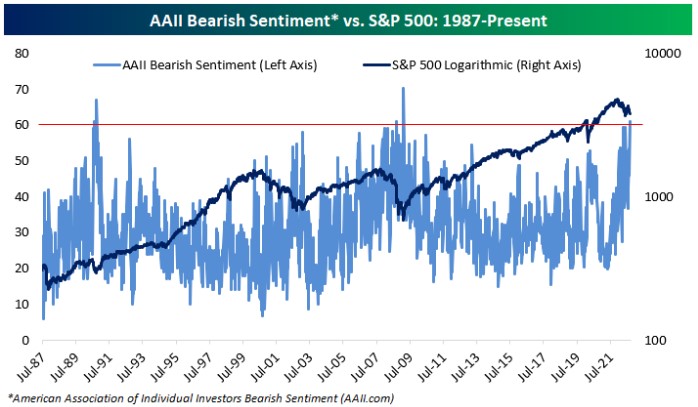
News from the past week shows us what we already know: the market’s mood is nasty right now and the few positive catalysts tend to be drowned out by negative noise. That shows up in market breadth (stocks advancing vs declining, currently the lowest it’s been in decades), volatility levels, and investor sentiment surveys. Sentiment is a known contrarian indicator, albeit an imperfect one.

This chart from Bespoke Investment Group shows the American Association of Individual Investors sentiment survey over recent decades. You’ll see via the red line that we’re at the level of extreme investor bearishness. News like this should make the contrarian’s ears perk up because, as the Warren Buffet quote goes, we should buy when others are fearful. But the timing on this isn’t perfect. The next chart uses the Great Financial Crisis to show that extreme bearishness can begat more extreme bearishness in the short-term before the market finally turns positive.
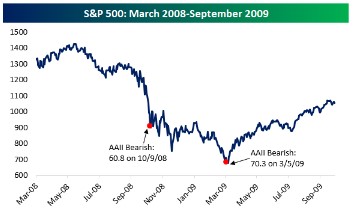
The good news is that from a historical perspective, from this point on and even more so should sentiment worsen from here, return expectations for the year ahead and beyond only get better.

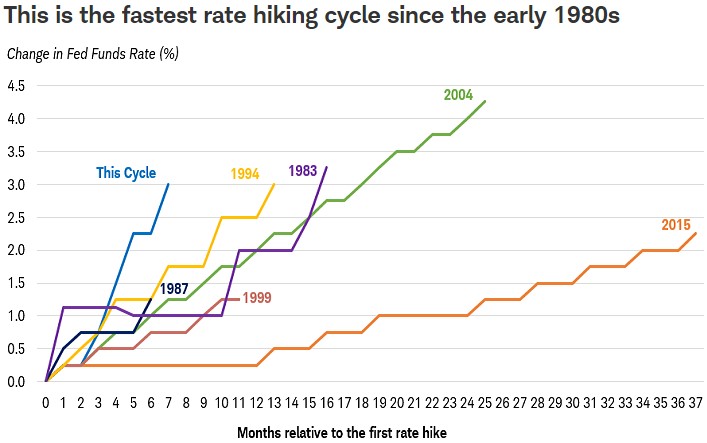
What could make sentiment get worse? The Fed. They raised rates again by 0.75% last week for a total of 3% this year. A major problem with this is, even as Fed Chair Jerome Powell has reiterated in recent days, rate increases “have a long and variable lag”, meaning that even one increase can take months to play out across the economy. And we’ve had five since March with more expected. There’s a growing risk that the Fed has pushed too far too fast, setting the stage for unanticipated consequences within the economy. Also in recent days members of the Fed, including the Chair, have doubled down on their willingness to allow people in the economy to go through “pain” while trying to avoid “deep, deep pain” (whatever that means) as the Fed fights inflation. It’s reasonable if statements like those don’t inspire a lot of confidence.

This next chart from JP Morgan provides some historical context for Fed hiking cycles and it’s easy to see the quickness of this one. As the Fed lowers rates they’re said to be spiking the punchbowl. If you’ll pardon the analogy, these rate increases could be like walking into the party and doing five tequila shots at the door. Maybe you’d be okay if you spaced your shots throughout the night. But slam five back-to-back and you’re asking for a long night and a hangover.
The rapid pace of rate hikes coupled with evolving rhetoric from the Fed have roiled the bond markets this year. And comments like, “Nobody knows whether this process will lead to a recession,” coming from the Fed Chair last week don’t help, even though he sounded reasonable and truthful (would investors rather he lied?). Nonetheless, it freaked investors out. The Bloomberg Barclays Bond Index, sort of like the S&P 500 for the bond market, declined a bit further and is down almost 14% this year, something very rare for bonds.

These gyrations have led to inversions within the yield curve, an important indicator that we’ve discussed before. These inversions steepened last week.

For example, as I write you can buy a US Treasury maturing in two years and earn an annual rate of 4.26%. If you bought a 10yr bond you’d earn 3.85%. That lower yield on a longer bond (the inversion) doesn’t ordinarily exist and is said to be a strong indicator of a looming recession. And for many investors the difference being relatively large cements recession expectations.

NPR had a good article (with audio, about 4 minutes) discussing the bond market this year. Give it a listen for a straightforward reminder of how bonds work and why, even amid all the chaos, they’re still good to own.

https://www.npr.org/2022/09/25/1124838564/stocks-and-bonds-both-get-clobbered-this-time-heres-whats-behind-the-double-wham

Consumers are facing challenges but it’s not all bad. Inflation is high but some prices, such as for gasoline, have been falling. Last week the AAA national average price for gas ended its especially long run of 98 days of declines. This next chart from Bespoke shows what a wild ride it’s been for gas prices this year.
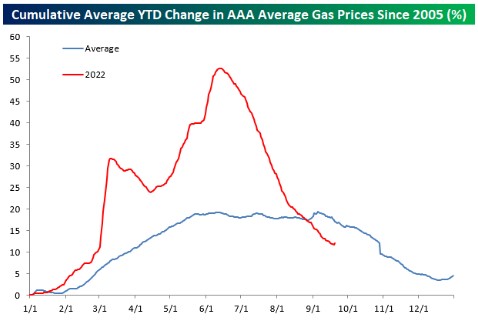
Gasoline is a relatively small component of the CPI inflation measure, but it’s psychologically important for consumers, with lower prices usually being a boon for confidence. But not lately. Maybe that’s because compared to last year gas prices are still about 26% higher and housing costs, a larger portion of CPI, are up with no near-term signs of slowing. On the positive side, consumers and investors are holding a large amount of cash measured in the trillions. This lessens the impact of inflation for most people and provides money to invest when, and not if, sentiment finally turns positive.

So what are you supposed to do with your investments in this sort of environment? In all seriousness, hang on for dear life. We’ve been through a lot of rockiness and there may still be more to come. Your investments have been taking a beating, but their prices will recover.

Remember that the thousands of stocks represented in your diversified portfolio are actual companies that are still in business. They were today and they will be tomorrow. And the bonds are issued by entities like the US Treasury, high-quality corporations, and perhaps states and municipalities. The vast majority of these bond issuers will continue to pay interest on schedule. The share price of the stocks and bonds has fallen, mostly because it’s too hard to price them amid all the uncertainty, but their fundamental, long-term value remains.

Focus on structural issues like investment quality, cost, and rebalancing. The latter has been challenging this year for a variety of reasons, but the process still works and the discipline still adds value.

The other thing to do: Ask questions. Don’t let them fester. You’re likely in better financial shape than you realize, or than it seems from watching the news, so try not to let anxiety get the better of you.

Here are a couple links to Bespoke’s work if you’d like to check out their research.

https://www.bespokepremium.com/interactive/posts/think-big-blog/the-streak-is-over

https://www.bespokepremium.com/interactive/posts/chart-of-the-day/chart-of-the-day-bearish-sentiment-soars-but-might-not-have-peaked

Have questions? Ask me. I can help.

  • Created on .

Contact

  • Phone:
    (707) 800-6050
  • E-Mail:
    This email address is being protected from spambots. You need JavaScript enabled to view it.
  • Let's Begin:

Ridgeview Financial Planning is a California registered investment advisor. Disclaimer | Privacy Policy | ADV
Copyright © Ridgeview Financial Planning | Powered by AdvisorFlex