The advent of so-called prediction markets is one of more ridiculous outcomes we’ve seen from the financial services industry in recent years, and that’s saying something. You have likely heard of these markets lately where individuals can place bets on all sorts of predictions, even random stuff that would make you laugh if not for the actual money being wagered. These markets are also said to have been a venue for insider trading related to the Iran War, White House press conferences, the capture of Nicolas Maduro in Venezuela, and even the electrical grid in Paris in recent days.
While it’s arguably feeding a need for certain consumers, the online prediction betting concept has been growing to the point, it seems, where the typical user of these platforms is in way over their head. It’s a Wild West frontier town in desperate need of a sheriff.
I have opinions about using gamification with investing, and stronger opinions about gambling masquerading as investing, not to mention the companies who set themselves up to win regardless of how their customers fare, just like the “house” does with traditional gambling. Most people generally understand that dynamic when applied to a brick-and-mortar casino. Except these days the “casino” can easily don the cloak of legitimacy via clever marketing, touting by paid social media influencers and the financial press, and the backing of prominent individuals in the financial world. All this makes it easier, I think, for prediction market providers to be growing so rapidly while so many people in the background are losing money.
I was considering writing about this when I read a piece from Schwab’s Chief Investment Strategist, Liz Ann Sonders. I’ve been reading her stuff for years and took note of the directness of her call to action related to the urgent need to educate investors, especially younger ones, on the differences between gambling and investing. It’s one of those cases where someone else said it better than I ever could, so I’m sharing it with you here.
Along these lines, here’s most of the article after I cut maybe a third to keep the length down. However, the full article has more detail, so a link is below if you’re interested.
From Schwab…
There is a concept that has long anchored the philosophy of long-term wealth creation: owning. When you invest in a stock, a bond, or a diversified portfolio, you are acquiring a claim on future cash flows and productive assets—on the compounding engine of capitalism itself. You are not speculating. You are not wagering on an outcome and walking away with either a windfall or nothing. You are a participant in the ongoing enterprise of wealth creation, and that distinction matters more than it may seem at first glance.
Gambling operates on an entirely different logic. The gambler hopes. The investor owns. Both involve uncertain outcomes, and both require accepting the possibility of loss. But the underlying architecture of each is fundamentally different. A diversified portfolio of equities and bonds (and other alternative asset classes for some investors)—held through cycles and volatility—historically has rewarded patience and discipline with real, compounding returns, although past performance is no guarantee of future results. The house in casino gambling, a sportsbook, or a prediction market is structured to help ensure that, in the aggregate, it wins, and the participants, in the aggregate, do not.
This distinction has never been more important to articulate clearly. The youngest generation of investors is being inundated with the message that investing and gambling are essentially the same thing. The platforms and personalities delivering that message have worked hard to make the experience look and feel like a casino, emphasizing entertainment, instant gratification, and the thrill of placing a bet on nearly anything.
Prediction markets have grown exponentially, as shown in the chart below. It's not just monthly volume growth, which has risen to more than $25 billion since 2024 according to Dune. It's also total transactions, which have skyrocketed from about 240,000 to more than 200 million, while monthly active users have grown from about 4,000 to almost 900,000 (Dune). At the same time, a March 2026 report from Citizens JMP Securities covering the period from July 2025 to mid-March 2026, showed that prediction market users experienced higher losses than users of other gambling products, with a median loss of 8% compared to a loss of 5% for sports bettors.
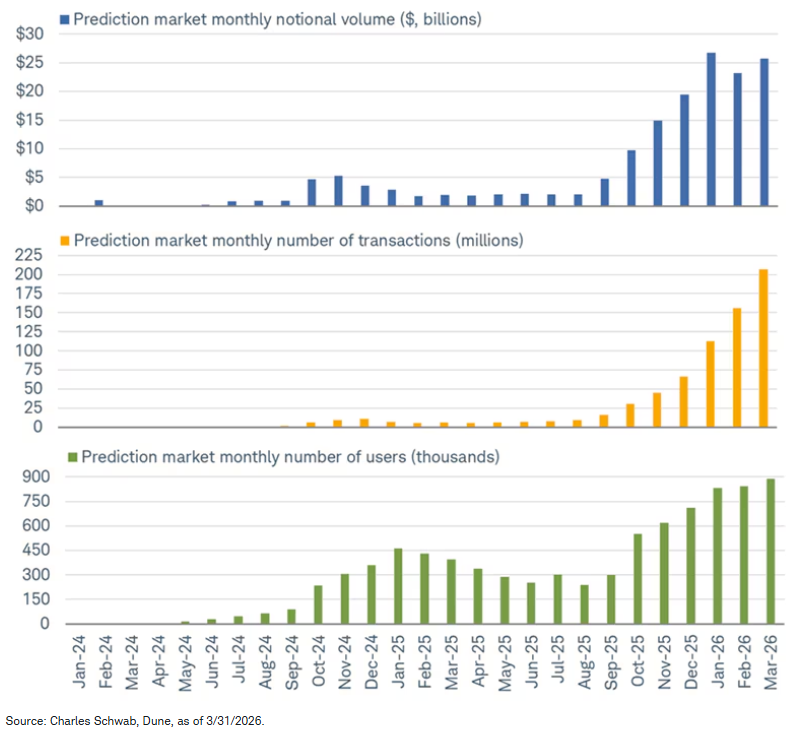
The language often used to advertise these platforms is seductive. However, nearly absent from this messaging is any serious acknowledgment of the financial risks involved, or any honest reckoning with what the data actually show about outcomes.
This is not a minor cultural shift. Frankly, it is a financial literacy crisis in the making. UC San Diego Rady School of Management studied more than 700,000 online gamblers over five years through 2023, tracking digital payment records across 32 states. Researchers found that fewer than 5% of online sports gamblers have withdrawn more money from their gambling apps than they deposited. Let's flip that sentence: More than 95% of participants are net losers over time. This is not a feature of bad luck or poor timing—it is the mathematical inevitability built into these products by design.
A landmark 2024 working paper by economists Scott R. Baker, Justin Balthrop, Mark J. Johnson, Jason D. Kotter, and Kevin Pisciotta—"Gambling Away Stability: Sports Betting's Impact on Vulnerable Households"—provides some of the most rigorous evidence yet of what is actually happening to household finances as online betting spreads across America. Using transaction data from more than 60 million Americans and analyzing behavior in roughly 230,000 households from 2010 through September 2023, the researchers explored the staggered state-by-state legalization of online sports betting following the Supreme Court's 2018 ruling to isolate the causal impact of gambling access on financial outcomes.
The findings are jarring. When online sports betting became available in a state, participation spread quickly and it did not slow down. Users who were net losers did not gradually learn their lesson and step back; instead they bet more. The research found not only an expansion among new users, but a pattern in which losing participants increased their wagering over time, a dynamic consistent with the addictive behavioral profile these platforms are designed, consciously or not, to cultivate.
[…]
To say that much changed in the aftermath of the pandemic is a simplistic understatement. Much of the post-pandemic era has been dominated by what Kevin coined as a "vibepression." For several years, there has been a depression in consumer sentiment and confidence metrics, despite a growing economy, impressive stock market gains, and several record highs in household net worth. The initial catalyst was the inflation spike in the immediate aftermath of the COVID-19 pandemic and Russia's invasion of Ukraine in 2022. For younger millennial and Generation Z folks who have never experienced significant price increases, it was a particularly shocking and strange environment—not least because the economy escaped a recession, home prices surged, and stocks recovered relatively well.
[…]
At the heart of this issue is the fact that younger people today continue to see solid "hard" economic data—such as resilient gross domestic product (GDP), surging AI business capital expenditures, and low initial jobless claims—but they feel very little, if any, benefits. The traditional mechanism that translates better data into better sentiment has weakened, if not broken, as affordability has taken over as the chief issue. That has helped pave the way for more speculative efforts to build wealth, with the belief that it can happen faster compared to what are thought of as more traditional methods, like purchasing a house or investing in the stock market.
A recent survey from Northwestern Mutual—conducted by The Harris Poll—provides supporting evidence for that. As shown in the chart below, when asked if they agree with the statement, "I invest, or may invest, in high-risk or speculative investments because I feel financially behind," 80% of Gen Z respondents said yes. That compares to 75% of millennials, 66% of Gen Xers, and 51% of baby boomers.
[…]
The conflation of investing and gambling is not entirely new. Critics of financial markets have made the comparison for as long as markets have existed. But there is a meaningful difference between a cynical critique and a deliberate business model built around blurring the line. Prediction markets and sports betting platforms are increasingly marketing themselves to the same demographic that the financial services industry is trying to reach with a very different message—one about the importance of saving, compounding, and investing for the long term. The competition for mindshare and wallet share is real and consequential.
For those who understand what they are doing and can afford to lose what they wager, responsible gambling is a legitimate form of entertainment. There is nothing inherently wrong with placing a bet on a football game, just as there is nothing inherently wrong with buying a lottery ticket. The problem arises when that activity is dressed up to look like a wealth-building strategy, when the risks are obscured behind engaging interfaces and social reinforcement, and when a generation of potential long-term investors comes to believe that outcomes are random regardless of what approach they take.
They are not. That is precisely the point.
There is a bright line between placing a bet on a football game and investing to potentially achieve better financial outcomes over the long term. That line is not arbitrary, and it is not merely philosophical. It is grounded in the mathematics of compounding, in the historical record of equity and fixed income market returns, and in the behavior of patient capital versus speculative capital across every market cycle.
Investing is a discipline. It involves goals, time horizons, risk tolerance, and the willingness to stay the course when volatility makes that difficult. It is not about excitement or entertainment, though markets certainly provide plenty of both, uninvited. Research makes it clear that dollars diverted from equity/bond markets and savings vehicles into betting platforms are not being redeployed into equivalent forms of risk-taking. They are being consumed…the expected value is negative…the platform wins. The bettor, statistically and on average, loses—and loses more than they realize. The true cost is not just the losing bet, generally it is the compounded future value of the investment that was never made.
https://www.schwab.com/learn/story/gamblers-blues-betting-isnt-investing
Have questions? Ask us. We can help.
